What walking in our cities reveals about everyday priorities.
Written by Kritik Jain
Published on 1 February 2026
It was an ordinary evening walk to the local market in Gurugram. I stepped onto the service lane when a speeding car brushed past me, close enough to leave me stunned. Searching for a safer place to walk I noticed the footpath beside the road: broken, fragmented with an open drain and just ended. Not diverted. Just… stopped. In places where the footpath did exist, it was partially taken over by parked vehicles and small encroachments, leaving little space for anyone to walk. I looked around and realised that everyone else was walking on the road, inches away from moving vehicles. What unsettled me most was not the danger itself, but how unbothered people seemed by it and how worrying that kind of normalisation truly is.
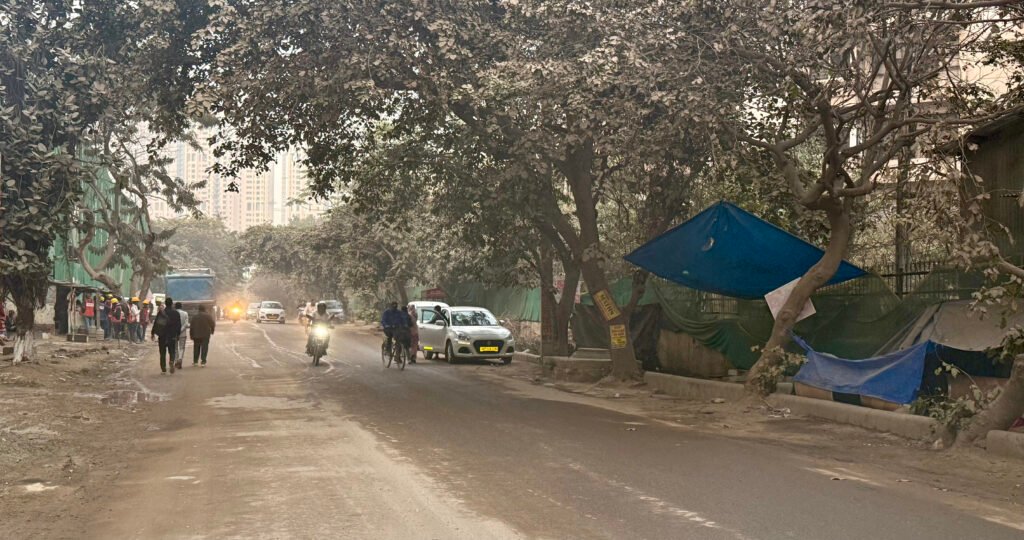
A footpath that ends abruptly is not merely a design oversight but a reflection of a deeper gap in how urban governance translates intent into on-ground experience. It has a huge impact on walkability, accessibility and equality. It shows how public infrastructure is planned in pieces, executed without continuity and delivered without accountability for how people actually use the city.
Walking is the foundation of all urban mobility. Almost 50% of public commute is done by walking. When that is treated as an afterthought, it tells us something important about priorities.
A broken or encroached footpath shapes our daily lives quietly. It costs us time with detours, slow walks. It costs us money by using auto rickshaws, cabs for walkable distances. Most important of all, it costs us our safety with children stepping onto the busy roads, elderly feeling helpless and confused, women constantly adjusting routes and the physically disabled becoming invisible due to less attention given to public Right of Way (ROW).
What does the system say?
In Gurugram, multiple agencies: Gurugram Metropolitan Development Authority (GMDA), Municipal Corporation of Gurugram (MCG) and others handle overlapping responsibilities for pedestrian infrastructure.
At the national level, schemes like AMRUT speak of urban transformation which includes footpaths/walkways, sidewalks, foot over-bridges and facilities for non-motorised transport such as bicycles.
The Hon’ble Supreme Court has also held that safe, accessible, disabled-friendly and encroachment-free footpaths are protected under Article 21 of the Indian Constitution as part of the Right to Life.
On paper, walking is not ignored. It appears in guidelines, policies, master plans and tender documents. Much seems to be happening officially. So where do the gaps remain?
According to a report, a footpath is not decorative, it is a primary mobility component of the public ROW, equal in legitimacy to carriageways and utilities. Yet pedestrians still account for nearly 20% of road deaths in India. When pedestrian accidents are viewed as isolated incidents rather than systemic risks, the opportunity is missed to prevent them through better planning and enforcement.
Responsibility is often fragmented. One agency builds the road, another the footpath, a third digs it up. A designated single point of responsibility is missing. A footpath that vanishes halfway still qualifies as “infrastructure” because paperwork reaches its destination even when people cannot.
Decisions are also made in isolation. Roads are widened without extending footpaths, utility works proceed without restoring walking levels and temporary diversions remain long after projects end. Urban systems often lean on temporary fixes to manage immediate needs while permanent solutions require sustained coordination and institutional alignment.
According to GMDA’s Right of Way Management Report 2024, Less than 50% of roads in Gurugram have standard footpaths and only around 2% of roads have dedicated cycle tracks. The on-ground outcomes show that coordination and accountability still needs to be strengthened. But institutions are only one part of the picture. Well, there’s one more layer to it and that is we the people.
Citizens, including many of us reading this, have adapted. We walk around potholes, accept encroachments and park our vehicles on footpaths “just for a minute.” We complain but we also comply. We, understandably adapting to the situation, often find temporary workarounds that inadvertently reduce walking space.
Even where footpaths exist, their purpose is frequently compromised. Walking space is occupied by parked vehicles, informal vending, extended private ramps and in some cases, two-wheelers using the pavement to bypass traffic. Vehicles halt on zebra crossings intended for pedestrians. Each such encroachment narrows the space meant for walking and gradually pushes pedestrians onto the carriageway, converting a routine commute into a safety risk.
In several neighbourhoods, residents refer to what they describe as a “parking mafia”, informal attendants who convert public walking space into paid parking. Land intended for collective use is treated as private control, reflecting weak enforcement and blurred accountability over the right of way.
The physical condition of footpaths further compounds the problem. Broken slabs, uneven surfaces, open drains and incomplete utility restoration turn pedestrian corridors into obstacle courses. A single misstep can result in serious injury, particularly for children, elderly citizens and persons with disabilities. Infrastructure meant to provide safety instead introduces risk.
The consequences extend beyond mobility. Walking is the most accessible and inclusive form of physical activity. When streets feel unsafe or obstructed, people reduce walking, indirectly contributing to sedentary lifestyles, higher pollution exposure from vehicular dependence and increased stress levels.
Cities frequently articulate commitments to sustainability and emission reduction. Yet the most sustainable mode of transport i.e. walking, remains undervalued in practice. Climate goals and environmental commitments cannot be meaningfully pursued if urban design makes walking unsafe, inconvenient or secondary.
So what can be done about this?
Institutions can begin by assigning single-point responsibility for pedestrian networks, not scattered ownership like ROW Management Cell (RMC) which includes mobility planners, infrastructure engineers, urban environment officials, traffic police, RWAs assisting local agencies in planning their projects.
Any agency that digs or repairs utilities must be required to restore footpaths to their original condition, with penalties for delays or incomplete work. Footpaths must be treated as continuous infrastructure and not “wherever space permits”. Digital grievance and monitoring which has a GIS-based ROW portal with transparent complaint tracking for citizens and time-bound resolution. Strengthen the implementation of GMDA’s Comprehensive Mobility Management Plan (CMMP), 2020 to reinforce its “people-first” priority. Success should be measured not by kilometres built but by continuity and usability.
Community engagement is the key to civic awareness. Citizens should stop normalising encroachment by shops, vehicles or ourselves. Report broken links consistently, not just on social media but through proper formal channels. Issues should be raised in ward meetings, RWAs and local forums. Support local initiatives that prioritise walking in RWAs, school zones, senior-friendly streets.
Finally, back the institutions when they do their part by recognizing effort, supporting implementation and encouraging accountability. Lasting change requires both enforcement and public support. The city works best when citizens, RWAs and institutions act in concert. A clear example of this approach can be seen on Sanath Road in Gurugram’s Udyog Vihar, developed as a “people-first street” with support from the Raahgiri Foundation, the project demonstrates how coordinated action and collaborative governance between state agencies and citizen institutions can translate intent into safe, usable public space.
Walking is an essential infrastructure, not a decorative add-on. Every footstep tells a story about our city. If we choose to notice and act, we can shape cities that move with us, not against us. When we start walking differently, our city will follow.
References
Hon’ble Supreme Court ruling: https://www.scobserver.in/journal/sc-directs-union-to-frame-pan-india-guidelines-for-pedestrian-safety/
Data, road deaths: https://www.hindustantimes.com/india-news/pedestrians-accounted-for-12-5-of-total-deaths-in-2023-govt-data-101756439739192.html
Data, Footpaths in Gurugram: https://www.gmda.gov.in/static/docs/ROW_Management_27.03.2024.pdf
Raahgiri Foundation: https://raahgirifoundation.org/street-redesign-redevelopment/
Leave a Reply