How colour became a language of identity, mobilisation and memory in Indian democracy
Written by Kritik Jain
Published on 4 March 2026
Ever been to a political rally in India? The first thing you notice is often not the leader or the issue being discussed, but the colours. Waves of saffron, green, blue and red move across open grounds. Party scarves are tightly worn by attendees. Flags flutter from motorcycles and cars. Entire neighbourhood walls are repainted in party colours, signalling allegiance to one group over another.
Democracy in India is not only heard in slogans and debates; it is also seen in shades that transform public spaces into a canvas of political expression. Colours in our democracy have become a language that translates ideology into something immediately recognisable.
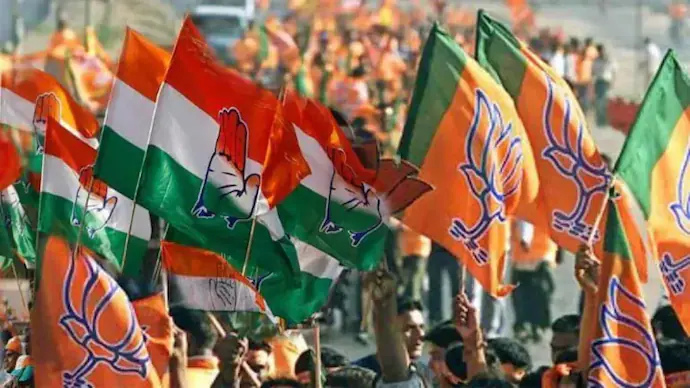
The importance of colour in Indian politics has historical roots. In the decades after independence, literacy levels varied widely across the country. Visual symbols therefore became essential tools of political communication. Over time, colours evolved from simple party identifiers into markers of collective identity. They simplified messaging and helped parties build emotional recognition among supporters. Today, party flags, posters, scarves, and even social media display pictures on platforms such as Instagram and X bind individuals into visible political communities.
Let us look at how different colours have come to represent various political traditions.
Saffron is perhaps the most visually dominant political shade in contemporary India. Historically associated with sacrifice and spirituality, it carries deep civilisational symbolism. In modern times, it is predominantly used by organisations linked to cultural nationalism and conservatism by parties such as the Bharatiya Janata Party. The colour’s resonance lies in its emotional charge, invoking heritage and collective pride.
Red has long signified labour movements and socialist politics. It is closely associated with parties like the Communist Party of India (Marxist) and trade unions across industrial regions. In states like Kerala and West Bengal, red flags defined the political landscape for decades and still does. Workers’ unions continue to march under red banners during protests demanding wage rights, reform and equity.
Green occupies a distinct space in India’s political landscape symbolising agrarian identity, regional aspirations and minority representation including muslims. Regional parties such as the All India Majlis-e-Ittehadul Muslimeen and farmers’ representative organisations such as Bharatiya Kisan Union dominate green in their flags and campaign material. Farmer mobilisations using this colour evokes fertility and rootedness in the soil, a powerful theme in a country where agriculture sustains more than a billion.
Blue represents one of the most significant social transformations in Indian politics. Deeply connected with Dalit and Ambedkarite movements. The Bahujan Samaj Party and Aazad Samaj Party (Kanshi Ram) have institutionalised blue as a symbol of social justice and constitutional rights. It is a declaration of dignity and political awakening among historically marginalised communities.
White carries powerful associations. It evokes peace, simplicity and ethical politics, often linked symbolically to Mahatma Gandhi and the khadi movement. White kurtas and caps often called a Gandhi cap signal public service and neutrality, even worn by leaders across party lines.
Above all party colours stands the Indian tricolour, our Tiranga. The national flag integrates saffron for courage and sacrifice, white for truth and peace, and green for faith and fertility, with the navy blue Ashoka Chakra representing law and dharma. Unlike partisan flags, the tricolour represents the constitutional foundation of the Republic, transcending electoral competition. It reminds citizens that democracy operates within a shared framework of rights, duties and the rule of law.
During elections, the colours move from symbolism to strategy. What once represented history and ideology becomes a practical tool of visibility, helping parties mark presence and energise supporters in the most immediate and visual way.
Yet the power of colour also carries risks. When political shades extend into social boundaries, they can intensify polarisation. Public debate may shift from policy differences to identity-based confrontation. Colour, once a tool of participation, risks becoming a marker of division. In such moments, democracy narrows. Instead of celebrating plural participation, colours may begin to signal suspicion or hostility.
Upholding constitutional values above party colours therefore requires conscious effort from both institutions and citizens. Political leaders must reaffirm that loyalty to the Constitution supersedes loyalty to any flag. Educational institutions can strengthen constitutional literacy so that young voters understand the principles underlying democratic competition. Media platforms can prioritise policy discourse rather than amplifying colour-coded divisions. Civil society initiatives can create shared spaces such as cultural festivals, public dialogues and community programmes, where citizens interact beyond partisan lines.
Above all, voters can ensure that political differences remain respectful and rooted in democratic values. The Constitution provides the grammar of democracy and colours are only its vocabulary.
India’s democracy is vibrant because it is plural. Its streets blaze with saffron processions, red marches, green farmer rallies, blue assertion gatherings and white-clad leaders invoking peace. Each colour represents history and ideology. Yet when the dust of elections settles, all these shades coexist under one tricolour.
India’s democracy thrives not because one colour dominates, but because many colours compete and coexist within a constitutional framework that belongs equally to all. In the end, beyond every banner and scarf, India remains diverse in its expression, yet united in its principles.
“भारत एक रंग नहीं, अनेक रंगों का समागम है।” (India is not one colour, but a confluence of many.)
References:
Political party colours in India – Scribd
https://thediplomat.com/2018/09/paint-it-saffron-the-colors-of-indian-political-parties
Leave a Reply